Bespoke metal components for industrial automation
Published - 11th Feb 2026
Delivering optimal design and metal forming solutions
As technology accelerates the pace of change in industrial automation, the demand for high-quality metal components has never been greater. In sectors such as warehousing, logistics and advanced robotics, automated systems depend on precision-engineered parts that perform consistently, reliably and to exacting specifications.
In this case study, we share how Investacast, part of Expromet Technologies Group, works in close partnership with an automation technology provider to deliver exceptional results by:
- Collaborating with their design team to optimise components for manufacture (DfM)
- Streamlining the supply chain by supplying over 30 different components through the most suitable metal forming processes – all managed seamlessly within the Group

Background
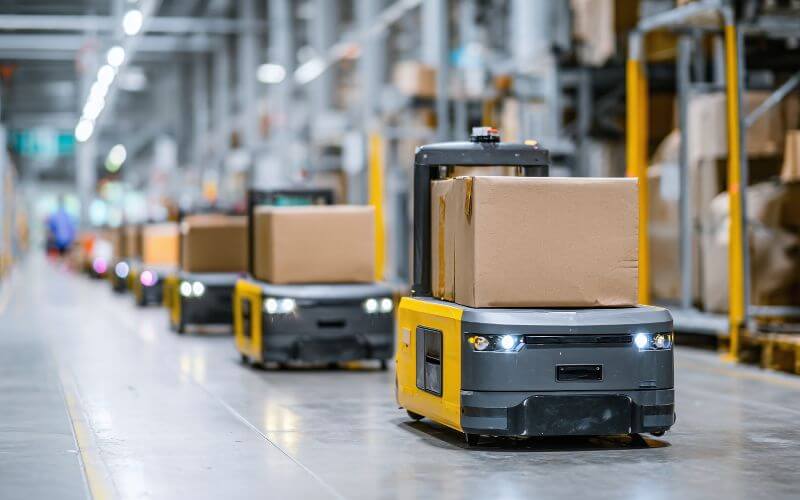
Automation providers are developing advanced storage and retrieval systems to maximise warehouse efficiency and minimise operational costs. At the heart of these solutions are fleets of robotic systems that navigate three-dimensional storage grids, enabling fast, accurate product selection and order fulfilment.
These systems must be scalable, reliable and safe. To achieve this, Investacast was engaged to design and manufacture critical metal components that would:
- Support vertical stacking in large-scale, multi-level grids
- Enable secure modular construction for rapid installation
- Provide seismic-compliant options
The technical challenge
The customer’s engineers approached Investacast with concept designs for a wide range of components. Our team applied design-for-manufacture (DfM) expertise to optimise each component for both performance and cost. This included:
- Lightweighting – shaping wall sections to reduce weight while maintaining strength
- Simplified assembly – design changes to combine parts or improve assembly times
Through both simulated and physical trials, we identified the most suitable manufacturing process for each part, balancing performance with cost efficiency.
Choice of metal forming process
With more than 50 years of experience, Investacast offers an extensive portfolio of metal forming processes, including:
- Investment casting
- Pressure die casting
- Water glass casting
- Gravity die casting
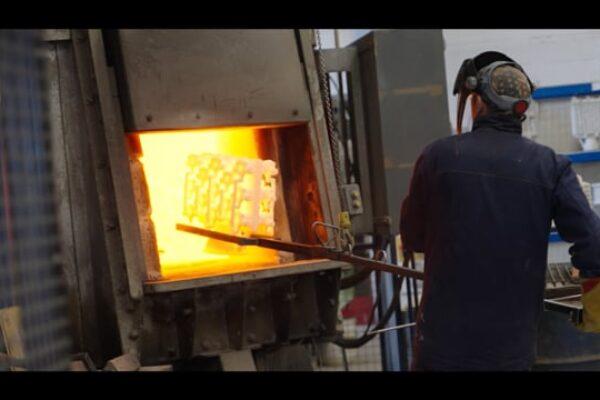
- Forging
- Metal Injection Moulding (MIM)
As part of Expromet Technologies Group, we also provide access to additional expertise and capabilities:
This breadth of options allows us to recommend the optimal solution based on size, volume, strength and delivery times, always ensuring the best cost-to-performance outcome.
The results
With Investacast’s support, the automation provider has been able to deliver easy-to-assemble, lightweighted components for construction of its large-scale grid systems. Achievements include:
- Over 30 different components, varying from 250 grams to 9 kilograms
- Materials including mild steel, carbon steel and aluminium – each selected for suitability and cost efficiency
- Processes including investment casting, water glass casting, sand casting, shell moulding, pressure die casting and sheet metal pressing
- Components designed to operate with seismic-compliant options.
Expert insight
Steve Burgess, Sales Manager at Expromet, explains:
“Our team was key to getting components from CAD concepts into production against challenging delivery dates. Working closely with the customer’s engineering team, we helped refine designs for manufacturing and identified the most suitable processes for each part.
Precision, reliability and on-time delivery are essential in industrial automation. By drawing on the full capabilities of Investacast and the wider Expromet Technologies Group, we ensure every component meets specification while delivering the best possible balance of cost and performance.”
Investacast components for industrial automation
This project demonstrates how Investacast supports the industrial automation sector with precision-engineered components, expert design input and access to the most suitable manufacturing processes. By combining deep technical knowledge with the broader capabilities of Expromet Technologies Group, Investacast helps automation providers achieve performance, reliability and cost efficiency in their systems.
If you are developing industrial automation systems and need a trusted partner for metal components, contact Investacast today to discuss your requirements.
FAQs about metal components for industrial automation
- What types of metal components are used in industrial automation?
Industrial automation systems often require components such as struts, joints, brackets, housings, fasteners and guides. These parts must be strong, reliable and able to perform under continuous operation in demanding environments.
- Which metals are best for industrial automation components?
The choice depends on performance requirements. Aluminium is lightweight and cost-effective, carbon steel provides strength and durability, and stainless steel offers corrosion resistance. Each material can be matched to the needs of the automation system.
- Why is precision important in automation components?
Automation systems rely on thousands of moving parts. Even small variations in component tolerances can affect performance, efficiency and reliability. Precision-engineered components ensure consistent operation and reduced downtime.
- What manufacturing processes are used for automation components?
Common processes include investment casting, pressure die casting, sand casting, forging, sheet metal pressing and CNC machining. The right process is chosen based on size, material, volume and required tolerances.
- How does Investacast help optimise component design?
Our engineers provide Design for Manufacture (DfM) support, working with customer concepts to improve performance, reduce weight, simplify assembly and identify the most cost-effective manufacturing process.
- Can automation components be customised for specific systems?
Yes. Each automation provider has unique requirements. Investacast supplies bespoke components designed to fit seamlessly into specific systems, including options for modular construction, seismic compliance and fire-risk containment.
- How do environmental conditions affect component choice?
Automation components often operate across a wide range of temperatures, from cold storage to high-heat environments. Materials and finishes are carefully selected to ensure durability and performance in these conditions.
- What are the cost factors in manufacturing automation components?
Costs are influenced by material selection, component size, production volume, tooling requirements and finishing processes. Investacast helps customers balance cost and performance by selecting the most efficient process.
- How does Investacast ensure quality in automation components?
All components undergo rigorous quality checks, including dimensional inspection, non-destructive testing and metallurgical analysis. We operate under ISO-certified quality systems to ensure every part meets specification.
- Why choose Investacast for industrial automation components?
With over 70 years of experience, access to multiple casting and machining processes, and the support of Expromet Technologies Group, Investacast delivers precision-engineered components, technical expertise and reliable on-time delivery.